A Napoleonic cipher and Grad's conjecture: what AI actually did
GPT-6 Astra helped decode an 1809 cipher letter to General Marmont and find counterexamples to Grad's 1967 plasma conjecture. What happened, and what it means.

Soumen Samanta · Co-Founder & CEO
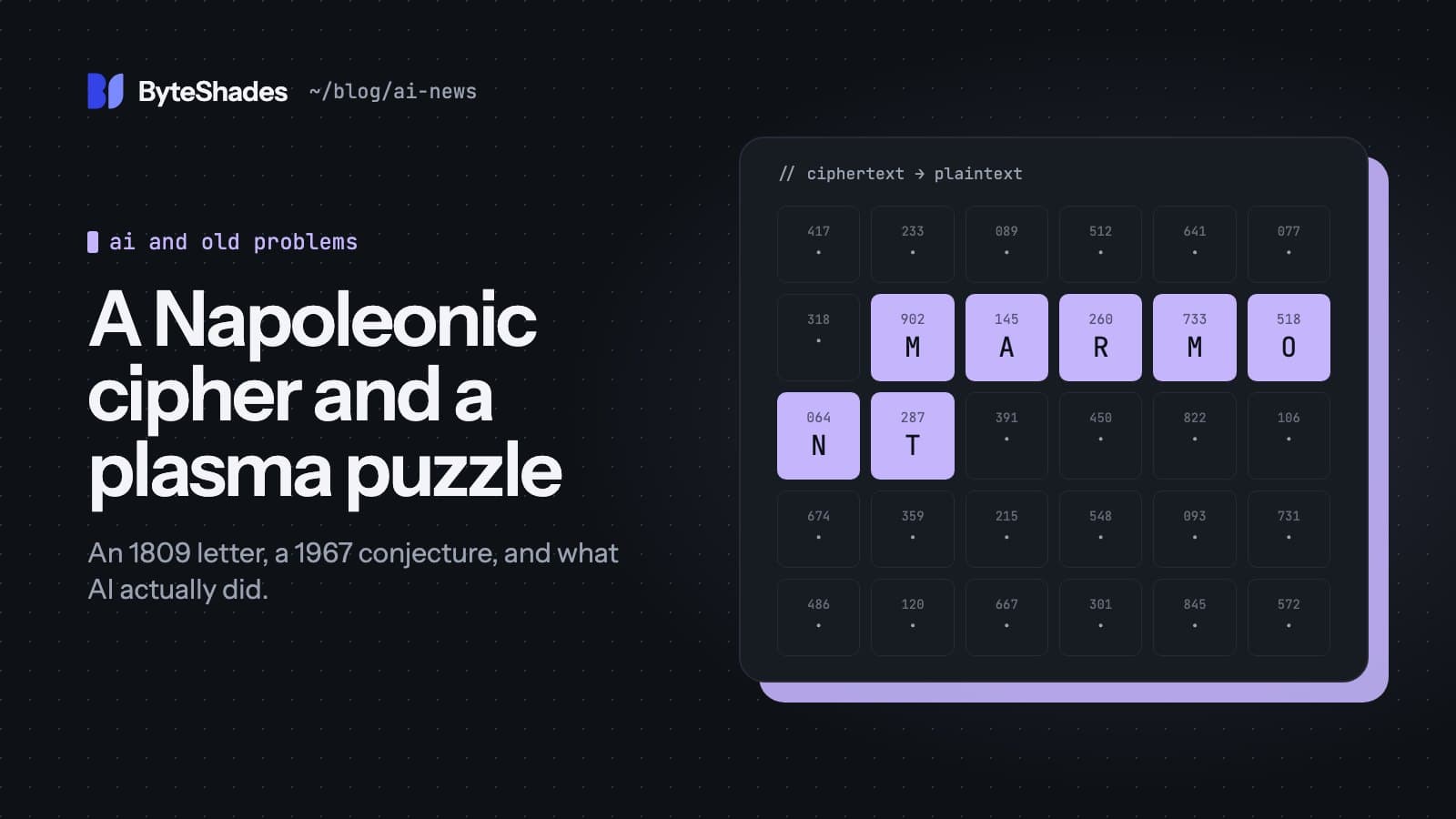
In September, two stories travelled fast under the same headline: AI cracks a problem nobody could solve. One was a coded letter from 1809, the other a question in plasma physics from 1967. We read the original write-ups and papers. Both results are real, but the details differ from the short versions in several ways, and the details explain why AI managed these two problems and not others.
The cipher letter to General Marmont
What the letter is
The letter is often described as Napoleon's, but he did not write it. It was sent from the headquarters of Eugène de Beauharnais, Viceroy of Italy, on Napoleon's orders. The recipient was Auguste de Marmont, then a general commanding French troops in Dalmatia. He became a marshal only in July 1809.
The only known copy is a single printed plate in a 1969 article by J. Vilcoq in the Revue historique des Armées. The scan is 1,202 by 1,836 pixels, which leaves about 19 pixels for each handwritten sign. Cipher collections had listed the letter under 1807. Carter Church, who solved it, re-dated it to late March 1809 from its content, a few weeks before Austria invaded Bavaria on 10 April 1809 and started the War of the Fifth Coalition. The "217-year-old letter" in headlines depends on that new date.
Why it resisted
It is a homophonic substitution cipher. Common letters such as E have several interchangeable signs, so counting how often each sign appears, the usual first attack on a substitution cipher, tells you little. The letter also uses whole-word signs and a few nulls, signs that mean nothing and are there to mislead.
| Feature | Count |
|---|---|
| Cipher units in the letter | about 1,300 |
| Distinct signs in the final key | 155 |
| Signs that stand for whole words | 27 to 29 |
| Nulls | 4 |
It was not a blank slate. The French cipher historian Daniel Tant had already published values for 33 signs, which made about a third of the text readable. Every word-sign was still unknown.
What the model did
Church, who says he had never broken a cipher before, describes the process in a public write-up. GPT-6 Astra did most of the work in about six hours of run time, with "a few evenings" of his own on top:
- It cut the plate into rows and transcribed the signs, deciding which slightly different marks were the same sign written twice.
- It ran a search that tried possible keys and scored each result by how much it looked like French, using statistics of letter sequences in real French text.
- It worked out the word-signs and checked each proposed value against every place that sign appears.
- As a control, it re-ran the solver with Napoleonic texts removed from its French model, and got the same reading. That matters: it shows the answer was not produced by a model that already "knew" what such letters say.
Church published the key, his transcription and scripts to check and reproduce the result.
What it says, and how sure we can be
The letter is a military briefing. It lists the positions of French and allied forces, including the Bavarians, Poniatowski's Poles, the Saxons and the corps of Davout, Masséna and Oudinot, and tells Marmont not to be alarmed by small enemy forces.
Cryptiana, a long-running catalogue of historical ciphers kept by Satoshi Tomokiyo, now lists the letter as solved. Five signs are still uncertain, with alternatives such as "de" or "dans". Church says none of them changes the meaning. We found no published comment from an academic historian yet, and the whole reading rests on one low-resolution reproduction rather than the original manuscript.
Grad's conjecture
The question
Fusion reactors hold a plasma, an extremely hot gas of charged particles, inside a magnetic field shaped like a doughnut. A tokamak's field is symmetric around the doughnut's axis. A stellarator gives that symmetry up and twists the field into a fully three-dimensional shape.
In 1967 Harold Grad argued that it was "very unlikely" that smooth equilibria of this kind exist without a symmetry, if the pressure varies across the plasma. An equilibrium here means a state where the plasma pressure and the magnetic force balance everywhere, on surfaces nested inside each other like the layers of an onion. Stellarator design codes assume such surfaces exist, so the question has practical weight.
Many reports said the plasma could now "remain stable". The conjecture is about whether these equilibria exist at all. It says nothing about stability, and neither paper claims stability.
Two papers, one day apart
| Paper 1 | Paper 2 | |
|---|---|---|
| Authors | Javier Gómez-Serrano, Lukas Liehr, Mitchell A. Taylor | Matt Landreman |
| Posted | 21 Sep 2026 | 22 Sep 2026 |
| Result | A proof that smooth equilibria without the classic symmetries exist, for a large family of shapes | Explicit formulas for two families of such equilibria |
| How it was checked | A 147-page proof, with the main results certified in the Lean proof assistant | Formulas checked by direct substitution and with standard equilibrium code |
| Role of AI, per the authors | Several models helped with calculations and Lean code; GPT-6 Astra was used only for late checking and proofreading | Solutions "discovered using" GPT-6 Astra Pro; every equation confirmed by the author |
So the popular version, "GPT-6 Astra found two counterexamples", is half right. Landreman's paper credits the model with the discovery, and his repository includes the original prompt and conversation. The first paper was led by its human authors, and they take responsibility for its correctness.
What it does not mean
Both are preprints and have not been peer reviewed. The solutions also have special features: in the first paper the field vanishes along the central axis and the result holds only above some large, unspecified size parameter; in the second, field lines close on themselves and the pressure profile is fixed by the construction. Landreman describes his solutions as useful tests for the software that designs stellarators, not as reactor designs. He also declares that he consults for Type One Energy, a stellarator company.
The result shows that such equilibria can exist. It does not make a better reactor.
Why these two problems fell
Both problems have answers that are hard to find and easy to check. A proposed key either turns the cipher into sensible French or it does not, and each sign can be tested against every place it occurs. A proposed equilibrium either satisfies the equations or it does not, and a proof in Lean is checked line by line by software. A model can make many wrong attempts cheaply, as long as something reliable rejects them.
Compare OpenAI's claim from 8 September that an internal model proved a form of finite-time blowup for the Navier–Stokes equations, one of the Clay Millennium Prize problems. The Clay statement does allow the forced version OpenAI addressed, but the claim is still under review. The Clay rules require journal publication and two years of scrutiny, and humans still have to confirm that the formal Lean statement matches the official problem. Priority is also disputed with mathematicians who posted related results days earlier.
When you read the next "AI solves a decades-old problem" headline, three questions sort the strong results from the weak ones: who checked it, how, and what exactly was shown.
Sources
- Breaking the Marmont Cipher, 1809 (Carter Church) carter.church
- Cryptiana: list of unsolved and solved historical ciphers cryptiana.web.fc2.com
- Code d'Eugène de Beauharnais (Daniel Tant, ARCSI) arcsi.fr
- Counterexamples to Grad's conjecture (Gómez-Serrano, Liehr, Taylor) arxiv.org
- Analytic toroidal 3D MHD equilibria and steady Euler flows with invariant surfaces (Landreman) arxiv.org
- Code and model transcripts for Landreman's paper github.com
- Quanta Magazine on OpenAI's Navier–Stokes claim quantamagazine.org
- Clay Mathematics Institute: official Navier–Stokes problem statement claymath.org
- #ai
- #gpt-6
- #cryptography
- #history
- #mathematics
- #fusion
Written by Soumen Samanta · Co-Founder & CEO, ByteShades
Full-stack developer who builds web apps and APIs with React, Next.js, Node.js, PostgreSQL and AWS.
LinkedIn