Gemini 4 Argon vs GPT-6.1 Sol vs Claude Sonnet 5.5
Three frontier models launched in three days. Prices, limits, benchmarks, cost per task and availability for Gemini 4 Argon, GPT-6.1 Sol and Claude Sonnet 5.5.

Souvik Samanta · Co-Founder & CTO
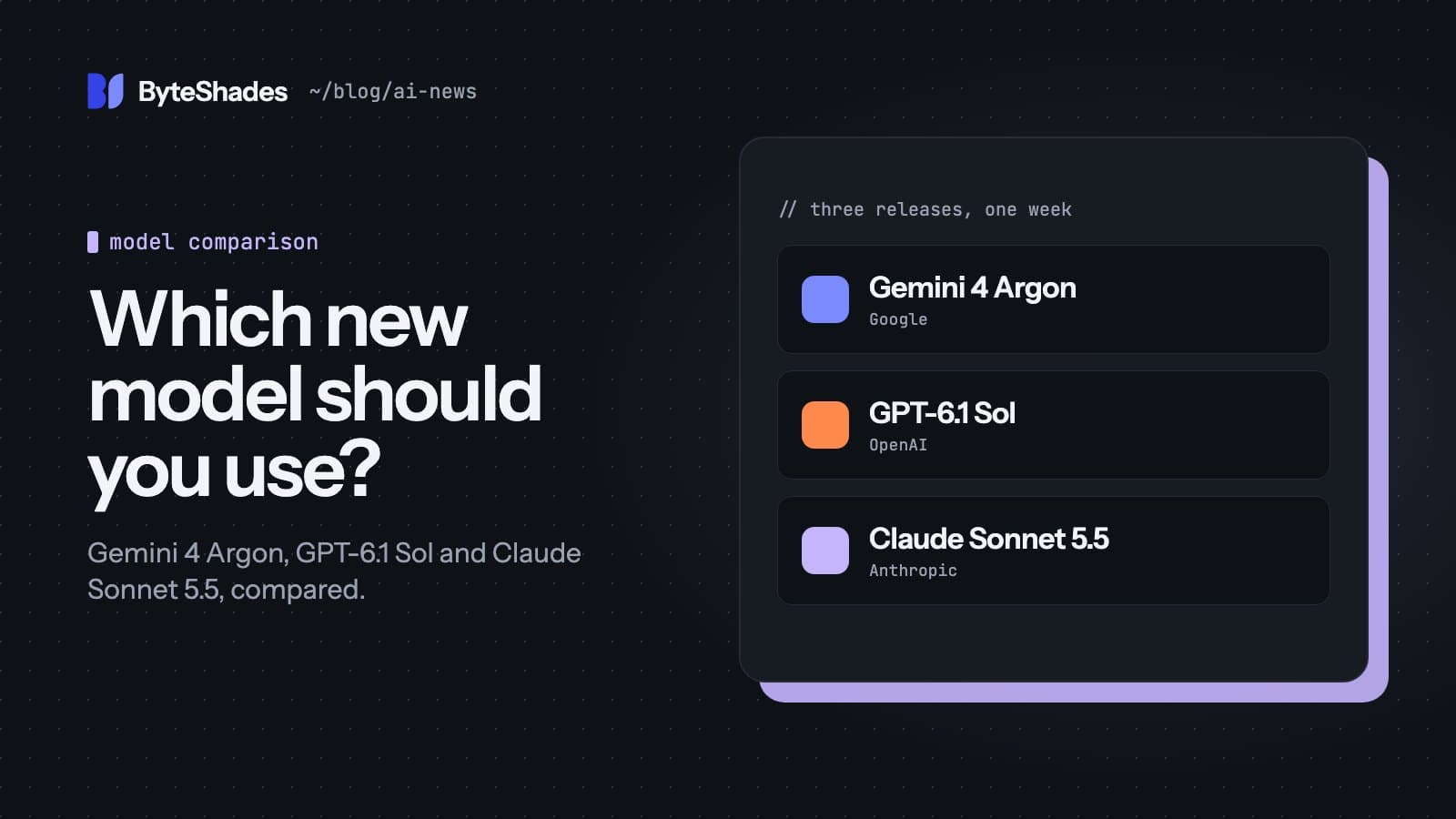
Anthropic released Claude Sonnet 5.5 on 28 September, OpenAI released GPT-6.1 Sol at its DevDay on 29 September, and Google announced Gemini 4 Argon on 30 September. All three are aimed at the same work: coding agents, long documents and multi-step tasks. This post compares them on what you can actually use today, what each costs, and where the benchmark headlines need a second look. Figures are from the vendors and from Artificial Analysis, an independent benchmarking site, as of 12 October.
The short answer
- You can't use Gemini 4 Argon yet. Google has given access only to a group of security researchers, with paid API customers and Google AI Ultra subscribers next, and no date.
- For the most capability per dollar, use GPT-6.1 Sol. It scores one point below OpenAI's flagship GPT-6 Astra on Artificial Analysis's index, at under a quarter of the cost per task.
- For the best Claude model short of Opus, use Sonnet 5.5, and pick its effort level deliberately. At maximum effort it is the second-highest-scoring model on the index, and also one of the most expensive per task.
At a glance
| Claude Sonnet 5.5 | GPT-6.1 Sol | Gemini 4 Argon | |
|---|---|---|---|
| Released | 28 Sep 2026 | 29 Sep 2026 | 30 Sep 2026 |
| API price per million tokens (input / output) | $2 / $10 | $2 / $10 | $2 / $10 for now, then $4 / $20 |
| Context window | 1M tokens | 1.05M tokens | 1M tokens |
| Longest single response | 128K tokens | 128K tokens | 1M tokens |
| Artificial Analysis Intelligence Index | 56 (max effort) | 52 (max effort) | 53 (high effort) |
| Cost per index task | $5.46 (max), $0.88 (high) | $0.72 (max) | $1.99 with launch discount, about $3.98 without |
| Can you use it today? | Yes: API, cloud platforms, Claude apps including the free plan | Yes: API, ChatGPT Work and Codex on paid plans except Go | No |
The input and output prices are identical for the two models you can use. The difference in cost comes from how many tokens each one spends on a task, which is why the cost-per-task row matters more than the price row.
Claude Sonnet 5.5
Anthropic positions Sonnet as the faster, cheaper companion to Opus, and the gap is now small. On Anthropic's own benchmarks Sonnet 5.5 is within a few points of Opus 5.5, and on Terminal-Bench 4.0, a test of coding-agent work in a terminal, it scores higher: 70.6% against 66.4%.
| Benchmark (Anthropic) | Sonnet 5.5 | Sonnet 5 | Opus 5.5 |
|---|---|---|---|
| Terminal-Bench 4.0 | 70.6% | 10.3% | 66.4% |
| CursorBench 4.0 | 55.5% | 34.1% | 57.8% |
| OSWorld 2.1 (computer use) | 80.1% | 57.0% | 81.8% |
| Humanity's Last Exam, with tools | 64.5% | 54.9% | 67.7% |
On Artificial Analysis's Intelligence Index, Sonnet 5.5 at maximum effort scores 56, second only to Opus 5.5 at 58 and ahead of GPT-6 Astra at 53. It gets there by thinking at length: at launch it used about 193,000 output tokens per index task, the most Artificial Analysis had measured. That makes the effort setting the main cost control:
| Sonnet 5.5 effort | Index score | Cost per task |
|---|---|---|
| High | 47 | $0.88 |
| Extra high | 52 | $2.01 |
| Max | 56 | $5.46 |
Claude Code and the Claude apps default to medium effort; the API defaults to high. Free Claude.ai users can chat with Sonnet 5.5.
If you are moving from Sonnet 5 through the API, check the migration notes first. Forced tool use now
returns an error, and so does setting temperature, top_p or top_k to anything but the default.
GPT-6.1 Sol
GPT-6.1 Sol replaced GPT-6 Sol only seven days after that model launched. OpenAI describes it as close to GPT-6 Astra's intelligence for a fifth of the price, and the independent numbers agree: 52 on the index against Astra's 53, at $0.72 per task against $3.26. It was the cheapest model in the frontier group at every effort level Artificial Analysis tested.
OpenAI's own results include matching GPT-6 Astra on DeepSWE, a long-horizon coding benchmark, at about one fifth of the cost, and scoring 2.2 points above Opus 5.5 on AutomationBench at about a third of the cost.
Two pricing details matter for long documents. Prompts over 272,000 input tokens are charged at twice the input price and 1.5 times the output price for the whole request. Cached input costs $0.10 per million tokens, 95% off. A faster "Ultrafast" mode is rolling out at $12 input and $60 output per million tokens.
In ChatGPT, GPT-6.1 Sol is in ChatGPT Work and Codex on the Plus, Pro, Business, Enterprise and Edu plans, but not on Go, and not yet in regular chat.
Gemini 4 Argon
On paper Argon is the strongest of the three. Google's comparison table has 19 benchmarks against GPT-6 Astra, Claude Fable 5.1 and Claude Opus 5.5. Argon leads 13, ties 1 and trails on 5.
| Where Argon leads | Argon | Next best |
|---|---|---|
| DeepSWE v1.1 (long coding tasks) | 77.9% | Opus 5.5, 74.2% |
| Vals Index (knowledge work) | 68.9% | Opus 5.5, 67.0% |
| Vals Finance Agent v2 | 65.4% | Fable 5.1, 58.9% |
| AutomationBench | 51.3% | Opus 5.5, 42.5% |
| Where Argon trails | Argon | Leader |
|---|---|---|
| FrontierSWE v2 | 55.0% | GPT-6 Astra, 65.5% |
| Terminal-Bench 4.0 | 57.4% | Opus 5.5, 66.4% |
| OSWorld-2.0 | 69.2% | GPT-6 Astra, 72.6% |
On Artificial Analysis's index it scores 53, level with GPT-6 Astra and Claude Fable 5.1, behind Opus 5.5 and Sonnet 5.5. Its $1.99 cost per task uses Google's 50% launch discount; at the standard $4 and $20 prices it would be about $3.98, slightly more than GPT-6 Astra.
Its most unusual feature is the length of answer it can write: up to one million tokens in a single response, up from 64,000 in Google's previous model. The others stop at 128,000. That suits generating very long documents or large amounts of code in one pass. One million tokens is very roughly 550,000 to 750,000 English words, depending on the tokenizer.
The hallucination number
Argon's 15% hallucination rate on Artificial Analysis's Omniscience test has been widely quoted as the lowest of any model. That test measures something narrow: when a model does not know the answer, how often it guesses wrong instead of saying it doesn't know. Artificial Analysis calls Argon's rate the lowest of any model scoring 45 or more on its index. Argon also answered fewer questions correctly than its rivals, 50% against GPT-6 Astra's 63%, so a low rate partly reflects declining to answer. For comparison, GPT-6 Astra's rate is 51%, Opus 5.5's 59% and Sonnet 5.5's 47%.
Which to choose
| If you need | Choose |
|---|---|
| The lowest cost for strong results today | GPT-6.1 Sol |
| A coding agent in a terminal | Sonnet 5.5, or Opus 5.5 if budget allows |
| Very long single outputs | Gemini 4 Argon, once you can get access |
| Predictable spend with Claude | Sonnet 5.5 at high effort, not max |
| A small, very cheap model | GPT-6 Luna or Claude Haiku 5.5, from $0.10 / $0.50 per million tokens |
Benchmarks are run by each vendor on its own choice of tests, and the independent index moves as models are re-run. Run your own task on two of these models for a day before committing a product to one.
Sources
- Introducing Claude Sonnet 5.5 (Anthropic) anthropic.com
- Claude Sonnet 5.5 model overview (Claude docs) platform.claude.com
- Introducing GPT-6.1 Sol (OpenAI) openai.com
- GPT-6.1 Sol model page (OpenAI API docs) developers.openai.com
- Gemini 4 Argon announcement (Google) blog.google
- Gemini 4 Argon benchmark table (Google DeepMind) deepmind.google
- Artificial Analysis model leaderboard artificialanalysis.ai
- Artificial Analysis on Gemini 4 Argon artificialanalysis.ai
- Artificial Analysis on Claude Sonnet 5.5 artificialanalysis.ai
- #gemini
- #gpt-6
- #claude
- #llm
- #model-comparison
- #api-pricing
Written by Souvik Samanta · Co-Founder & CTO, ByteShades
Software developer who builds LLM-powered web, Android and backend apps, with a background in NLP.
LinkedIn