OpenAI dots explained, and the open-source alternatives
OpenAI's dots are always-on agents with their own cloud computer. What they do, who can use them, the Pro plan changes and how the open-source clones compare.

Soumen Samanta · Co-Founder & CEO
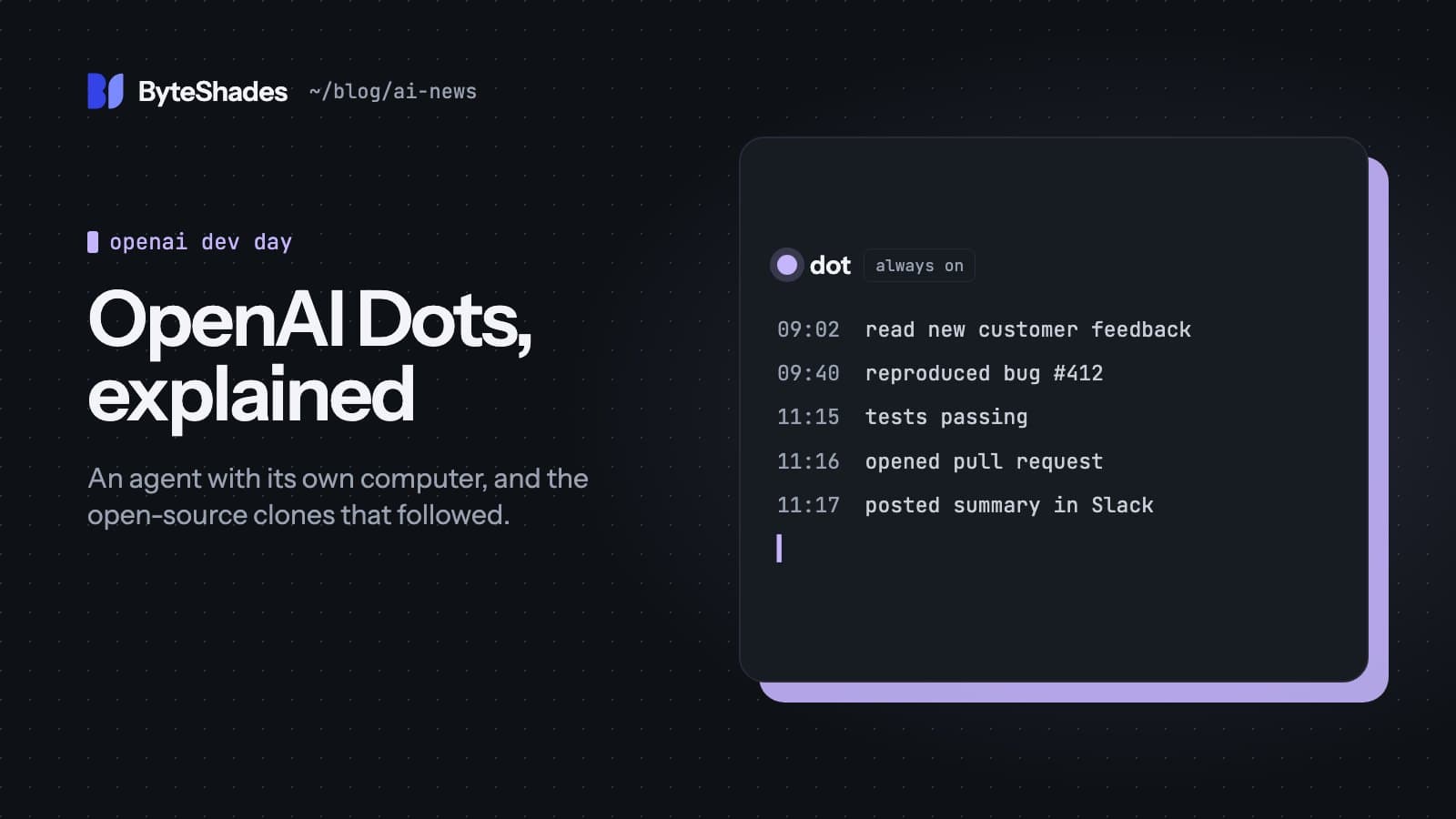
The biggest announcement at OpenAI's DevDay on 29 September was a new kind of ChatGPT feature called dots (OpenAI writes it in lower case). A dot is an AI agent with its own computer in the cloud that keeps working on your goals when you are not chatting with it. This post covers what a dot can do, who can get one, the ChatGPT Pro changes announced alongside it, and whether the open-source copies that appeared the same week are a real alternative.
What a dot is
A normal chatbot answers a message and stops. A dot has its own cloud computer with a browser, and it can keep working on a goal for days. OpenAI's own example is a developer's dot that watches customer feedback, fixes the bugs it finds, tests the fix and comes back with a complete pull request, with a video of the change attached.
What OpenAI says a dot can do:
- work on several projects at once, without you starting a new thread for each;
- connect to more than 4,000 apps through plugins;
- use your laptop as well as its own computer, if you allow it;
- show you its computer, so you can see what it did;
- take messages in ChatGPT on desktop, web and mobile, and in Slack and Microsoft Teams;
- take voice calls inside ChatGPT. Text messaging by SMS is "coming soon".
Dots run on GPT-6 Astra, OpenAI's most capable public model.
Safety controls
Because a dot acts on its own, the controls matter more than usual. Each dot runs on its own cloud computer, separate from yours unless you connect them. It can use your saved passwords without the model seeing them. You can write rules that allow an action, require your approval for it, or block it, and sensitive actions such as changing a password always come back to you.
Who can use dots
| Plan | dots |
|---|---|
| Free, Go, Plus | No |
| Pro | Yes, except in the EEA, Switzerland and the UK |
| Business Premium | Yes, in all supported regions |
| Enterprise, Edu, Healthcare | Beta, off by default, an admin must enable it |
The first dot comes with Pro or Business Premium at no extra cost. Chatting with your dot does not count against ChatGPT usage limits, but tasks it starts in Codex or ChatGPT Work do. You have to set up your first dot in the ChatGPT desktop app or a desktop browser; after that it works on your phone too.
The ChatGPT Pro changes
DevDay also changed the Pro plans, and the change is easy to miss. There are now three:
| Plan | Price per month |
|---|---|
| Pro 100 | $100 |
| Pro 200 | $200 |
| Pro 500 | $500, billed monthly only |
Pro 500 has the highest usage allowance and is the only Pro plan with Ultrafast, a faster mode for GPT-6 Astra and GPT-6.1 Sol that uses up your allowance eight times as fast.
Pro 200 stays at $200 but now includes a lower usage allowance. OpenAI's public help page does not give numbers. Its email to subscribers, as quoted by users and the press, says the Codex and ChatGPT Work allowance falls from 20 times the Plus plan to 10 times. If you were already subscribed to Pro 200 between 22 and 29 September, you keep the old allowance until 29 October. New subscribers get the lower one immediately.
The open-source alternatives
Within days, several projects on GitHub described themselves as open-source dots. None of them is a fully local, free equivalent, and each needs some paid service.
| OpenDots | Open Dots | opendots | |
|---|---|---|---|
| Repository | CopilotKit/OpenDots | Anil-matcha/open-dots | diggerhq/opendots |
| Licence | MIT | Says MIT, but has no licence file | MIT |
| Stars on 12 Oct | about 4,900 | about 5,700 | about 20 |
| Models | Any OpenAI-compatible API | Claude only, through Claude Code | Model-agnostic |
| Still needs | CopilotKit Intelligence (hosted, or a licensed self-hosted version); OpenAI's Realtime API for voice | A Claude account and Boat cloud sandboxes | The OpenComputer agent cloud |
| Status | Alpha | Prototype | Early |
OpenDots from CopilotKit is the closest in spirit. Each dot gets its own computer with a browser,
files and a shell, plus scheduled background work, per-dot tool connections that ask before doing
anything that changes data, and voice calls in the browser. Its README calls it "a template, not a hosted
product". It needs CopilotKit's own Intelligence service, either hosted or as a local evaluation build
that wants 12 GB of RAM and a renewable 30-day licence. CopilotKit's telemetry is on by default; set
DO_NOT_TRACK=1 to turn it off.
Open Dots by Anil-matcha runs Claude Code tasks in disposable cloud sandboxes, controlled from Telegram or a web page, and asks for approval before writing files, running commands or pushing to git. Its commit history shows it is an existing agent project renamed after DevDay rather than a new clone. It only works with Claude and cannot run local models. Its web interface has no real login yet, so do not expose it to the internet.
opendots from Digger is a small, model-agnostic take whose agents run on the OpenComputer cloud.
Is a dot worth it?
If you already pay for Pro outside Europe or for Business Premium, you have one, and the safest way to start is a narrow, low-risk task: summarising a feed, watching a dashboard, drafting rather than sending. Use the approval rules for anything that sends, buys or deletes.
If you want the idea without OpenAI, CopilotKit's OpenDots is the most complete template, but plan for real setup time and a paid model API. For developers who live in Claude Code, the Anil-matcha project is a quicker way to run tasks from your phone, provided you keep it private.
Sources
- Introducing dots (OpenAI) openai.com
- dots availability and setup (OpenAI Help Center) help.openai.com
- About ChatGPT Pro tiers (OpenAI Help Center) help.openai.com
- ChatGPT pricing chatgpt.com
- The Next Web on the Pro 200 usage change thenextweb.com
- OpenDots (CopilotKit) github.com
- Open Dots (Anil-matcha) github.com
- opendots (Digger) github.com
- #openai
- #chatgpt
- #ai-agents
- #dots
- #open-source
Written by Soumen Samanta · Co-Founder & CEO, ByteShades
Full-stack developer who builds web apps and APIs with React, Next.js, Node.js, PostgreSQL and AWS.
LinkedIn